Full Price, Full Heart: The Charity Shop Quietly Sitting Out the Sales Season
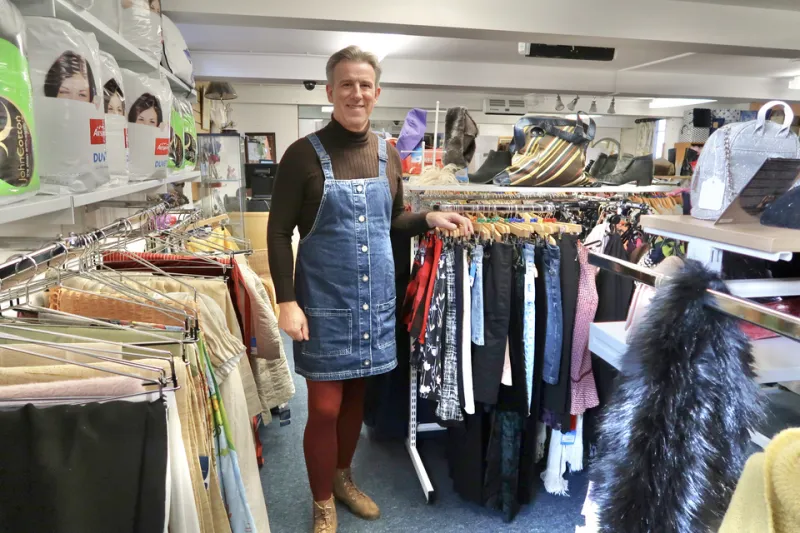
Photo: AntonDubeke1000, CC0, via Wikimedia Commons
There is a particular kind of quiet in a charity shop at 9.02am, before the door goes and the town gets busy. On the morning I visited, two volunteers were folding a rail of jumpers that had already been folded twice, and a third was standing back from the window display with the expression of a person who knows the fairy lights are not quite right yet.
Nobody was writing up a 40%-off sign. Nobody was taping a red sticker to anything. And that, apparently, is the whole point.
The one window on the street without a number on it
Black Friday lands on 27 November 2026, and between now and then the high street will do what it always does: countdown clocks, doorbuster queues, the strange collective amnesia about what anything actually cost last week. Independents will feel obliged to join in. Online giants will not need to try.
This shop — a modest two-window affair, run entirely by volunteers, raising money for a local advice and befriending service — has decided it is sitting this one out.
"People ask if we're doing anything for Black Friday and I say yes, we're doing full price," says Bev, who has managed the place on a rota basis since it opened in 2013 and who declines, cheerfully, to be described as the manager. "We had one volunteer suggest a half-price weekend a few years back. It wasn't a moral objection so much as a practical one. We'd have sold twice as much, made the same money, and lost a Saturday of everybody's weekend to do it."
There is a maths to it, but there is also a mood to it. The rail prices are handwritten, sensible and occasionally, deliberately, a little optimistic. A wool coat is £18. A pair of barely-worn boots is £12. A child's party dress — the sort with a netting underskirt that sheds glitter for years — is £4, and has been £4 since October.
Cheerful counter chat is the campaign
What the shop lacks in percentage-off signage it makes up for in the two minutes you spend at the till, which is where the real fundraising happens.
"If someone's buying a coat, I'll tell them what the coat does," says Colin, who volunteers Tuesdays and Thursdays and who can explain the charity's befriending service in roughly the time it takes a card machine to connect. "Not in a heavy way. You're not standing there with a collection tin. You just say: that'll pay for about a third of an hour with someone who hasn't spoken to anybody all week. Then you hand them their receipt."
The shop's takings go towards a small local charity that runs a drop-in advice session and a telephone befriending round for isolated older residents. It is the sort of organisation that never trends and never closes a road for a film crew, and which quietly absorbs the jobs nobody else wants to do.
Which is why the volunteers get a bit prickly about the phrase "bargain hunting".
The shelf with no price tag on it
Tucked at the back, near the changing curtain, is a shelf the shop has run since 2019. It is labelled, in faded marker, Pay What It's Worth.
On the day I visited it held a decent dinner service, a brass barometer, three hardbacks about the Dales and a working cassette deck. There is no ticket on any of it. You decide, you pay, you take it home.
"It started because we genuinely didn't know what to charge for a set of golf clubs," Bev admits. "Then it turned out people are mostly honest and occasionally extremely generous. Somebody paid £30 for a lamp last month. It's a lamp. We'd have asked eight quid for the lamp."
The shelf does a secondary job, too. It gives volunteers a way to talk about value without talking about discounts — a distinction that matters more than it sounds. A charity shop asking full price is making an argument: that second-hand isn't a consolation prize, and that the person on the other side of the counter is a neighbour rather than a customer to be beaten on price.
What the full price actually pays for
The shop's committee did look at the numbers once, properly, in 2024. They compared an ordinary weekend with a discounted one and found the discounted weekend brought in more footfall, more donations and slightly less money — with the added cost of a frazzled rota and one volunteer who swore off Saturdays for a month.
Since then the shop has taken a different tack: nothing off, but more on. Late opening on the first Thursday of the month, when the lights are on and the kettle is out. A corner of the back room given over to a jigsaw table, which has become a small social club of its own. A seasonal window that local schoolchildren help dress, on the strict understanding that nothing in it is for sale.
"The charity gets more out of a good window than a red sticker," says Colin. "People stop. They come in. They buy a mug. It's not complicated."
How to spend your Christmas money so it goes further
If you'd like your festive shopping to do a bit of local lifting this year, the volunteers have thoughts — offered gently, over a brew, and not as homework.
- Buy the full price on purpose. A charity shop's margin is the whole point. Haggling over 50p takes money straight out of a local cause.
- Ask what your purchase funds. Most volunteers will happily tell you. It is not an awkward question and it makes the coat feel better.
- Donate as you shop. The donation bag in the car boot has more value than the till receipt. Gift Aid on donations is worth asking about, too — a lot of shops can claim an extra 25%.
- Look for the unticketed shelf. Pay-what-it's-worth corners exist in more shops than you'd think, usually because nobody could agree on a price.
- Check opening hours before you set off. Volunteer-run shops keep volunteer-run hours, and turning up at 5pm on a Sunday is how you end up writing a grumpy review.
- Go on a weekday. If you want the chat, and the chat is half the pleasure, quiet mornings are when it happens.
The quiet victory of not joining in
On my way out, the window dresser had finally got the fairy lights where she wanted them — draped, slightly lopsided, entirely charming — and had stepped back to admire the effect. No percentage. No countdown. Just a hand-written card propped against a tin of Quality Street: Everything in this window is already a bargain. It's just also, honestly, worth what we're asking.
You could call it a protest, but it doesn't feel like one. It feels like a shop that has worked out what it is for, and has decided that being useful is a more attractive offer than being cheap.
Black Friday can have the queues. This one will be here on the Saturday, folding the jumpers again, kettle on.